Practical guide
What this article covers
How architecture studios can outsource construction documentation while protecting standards and deadlines.
Construction documentation outsourcing should begin with a sheet list and responsibility matrix. The risk is not simply an unfinished drawing. It is an apparently complete issue set whose details, schedules, and consultant information do not agree. External production support is most useful when your project architect can direct the decisions and inspect the resulting package at defined checkpoints.
Define the package by purpose
A pricing package, permit submission, and construction issue can have different requirements. Identify the intended recipient, review milestone, applicable office standards, and issue status. Do not describe a package as permit-ready merely because the drawings have been formatted; local requirements and professional approval remain separate responsibilities.
Create a sheet register with existing sheets, proposed additions, and the current completion status. Identify who will supply consultant information, specifications, product selections, and design decisions. A realistic scope includes the dependencies as well as the drawing list.
Assign ownership at the interfaces
Drawings become difficult where one scope meets another: wall assemblies and openings, ceiling layouts and services, floor finishes and thresholds, or equipment and clearances. Ask the production team to flag inconsistent references and missing information. Give your internal lead a clear route for deciding those questions.
A remote partner can draft and coordinate agreed information without taking over the architect-of-record role. Record who approves local code interpretation, design changes, consultant responses, and the final issue. This protects both the client relationship and the usefulness of the support arrangement.
Review a representative portion early
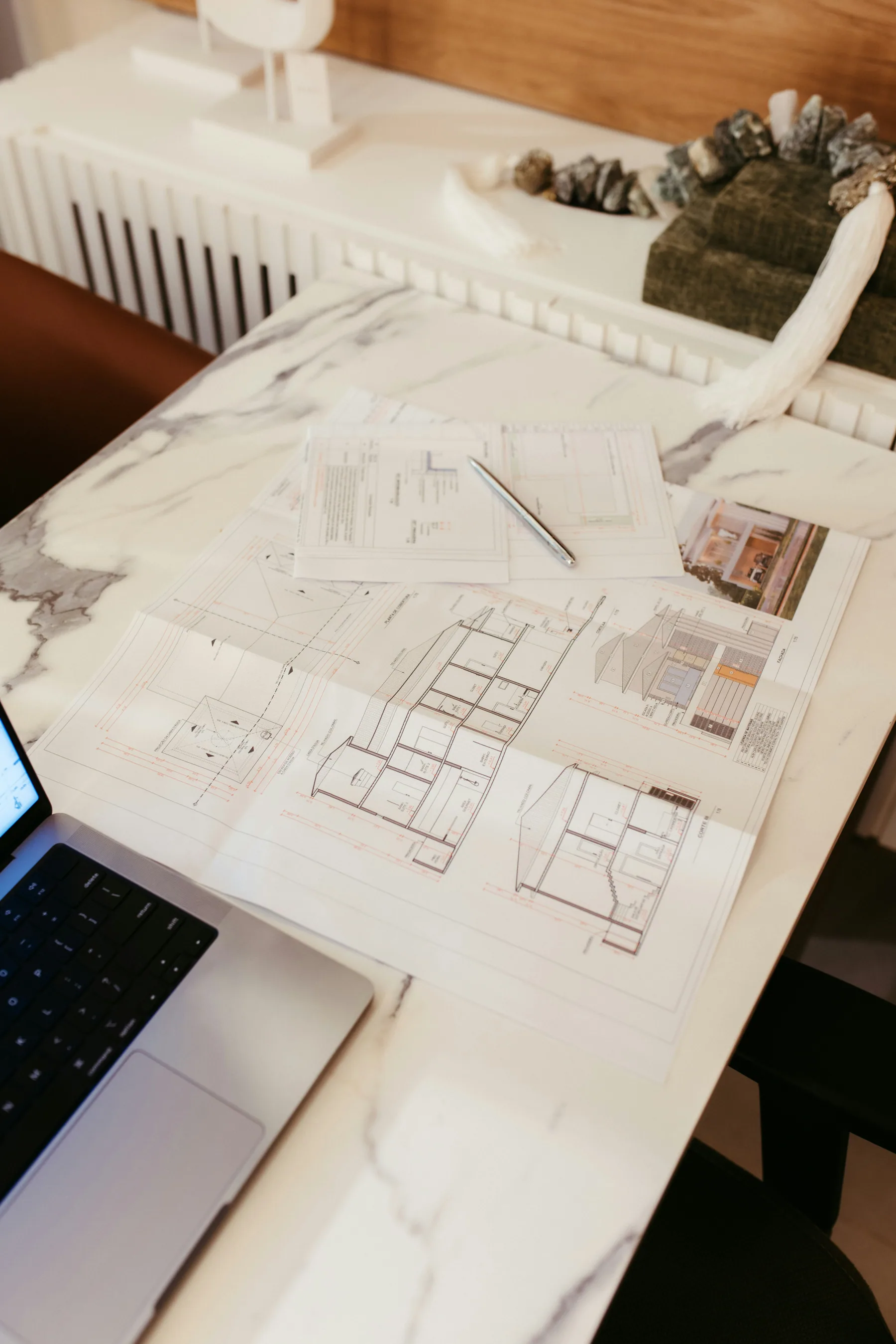
Select a group of linked sheets for the first checkpoint. A plan, enlarged area, section, and associated detail reveal more about documentation quality than four unrelated sheets. Review dimensions, notes, material references, and callouts together. Confirm the drawing standards before allowing the approach to spread across the package.
Return one consolidated set of comments. If two reviewers disagree, resolve their direction before sending another production instruction. Separating new design requests from corrections also keeps the fee and review allowance understandable.
Make quality control visible
The checking process should include the sheet register, revision information, cross-references, coordinated annotations, and the consistency of repeated conditions. It should also identify information that is intentionally incomplete at the current phase. A checklist is useful when it records what was checked and which issues remain open.
Ask for the PDF and editable deliverables specified in the agreement, together with the assumptions or questions log. Your own project review should occur before the package is issued externally. Production QA supports that review; it does not replace professional approval.
Test a defined documentation package
For an illustrative pilot, use an approved portion of a small commercial fit-out: selected interior elevations, a finish-schedule update, and their plan references. Confirm the supplied design information, output format, and a single review milestone. Exclude unresolved landlord or consultant decisions from the production completion promise.
Judge whether another architect can follow the returned drawings without guessing. Record incomplete inputs separately from drafting errors. That evidence gives a much better basis for expanding support than judging whether the first PDF arrived quickly.
Use the proposal to remove ambiguity
Before authorizing construction documentation outsourcing, confirm the sheet list, version, scope boundary, fee basis, review rounds, and change-control process. Identify the effect of late design decisions on the timeline. Agree how updated source material is announced and which issue supersedes earlier instructions.
Nest can help review a documentation backlog and identify a bounded starting package. Begin with the sheet register and a sample of the current work. Detailed or confidential project files can follow through the agreed access process.
Explore the next step
Review construction documentation outsourcing for the service scope, and compare Revit sheet production where it relates to your workload. The pilot project process explains the first assignment; our production scenarios describe typical inputs and outputs.
Related questions and practical guides
For more detail on staffing, standards, and specific production tasks, read the related guides below.
- How to Reduce Revit Documentation Bottlenecks Before a Deadline: Practical Revit documentation support guidance for teams dealing with sheets, views, schedules, annotations, and issue deadlines.
- How Architecture Firms Handle Deadline Surges Without Lowering Quality: A practical approach to adding architecture production support when drawing, Revit, and documentation deadlines stack up.
- Documentation Support for Contractors: As-Builts, Drawing Updates, and BIM: How contractors can use CAD, as-built drawing, BIM, and documentation support to keep updates and closeout information organized.
Need help with current production work?
Tell us which drawings, model updates, or renderings need attention and when you need them. We can review the assignment, confirm availability, and explain project-based or monthly support.
Book a project callSend a project brief